B2B packaging · Build
Flutemark
Brand System / Multilingual Platform
Visit Live Site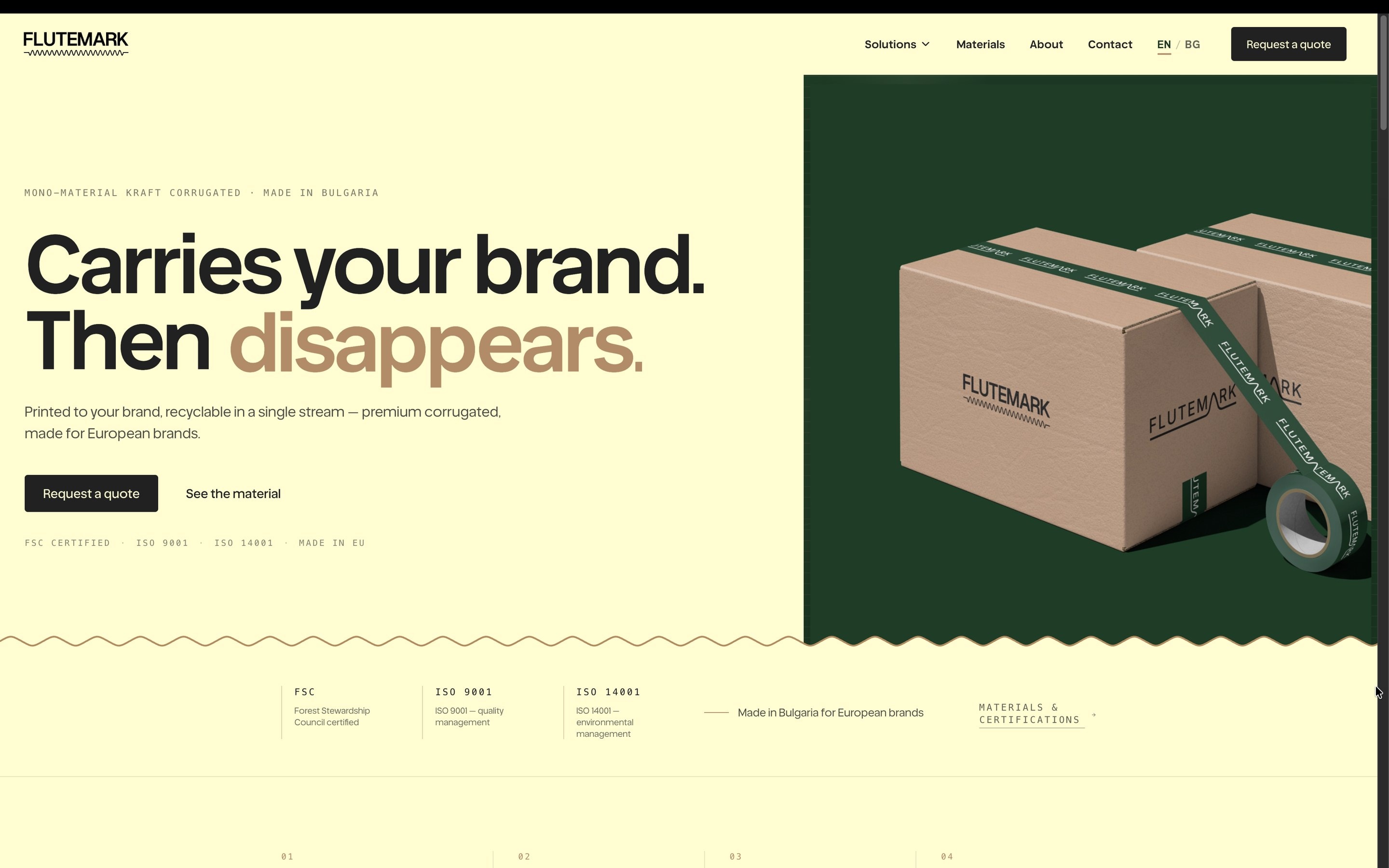
- Client
- Flutemark
- Timeline
- Strategy to live platform, 2026 — four languages since Aug 2026
- Tech Stack
- React 19, Vite 6, TypeScript, Tailwind v4, Framer Motion, Supabase Edge Functions, Resend, Vercel
- Live Site
- flutemark.com
In Brief
What
An end-to-end launch for Flutemark, a Bulgarian maker of FSC-certified, mono-material kraft corrugated food packaging: naming and three logo rounds, a full brand identity, a statically-prerendered site launched in English and Bulgarian and since extended to French and German (36 URLs across four locales), edge-function lead capture, and the email, search and asset infrastructure to run it, built end to end.
What was hard
A premium B2B site is the visible 20 percent. The hard part was textbook bilingual SEO (what most multilingual sites get wrong), a launch gated on build-time feature flags across Vercel environments, a real-device mobile gauntlet, and lead capture that actually delivers, all on a brand-new domain with zero sending reputation.
How
Name and identity first: three logo rounds into a full brand system (wordmark and corrugated flute device, a four-colour palette, the Helvena Grotesk type system, pattern library and brand guide). Then the platform: one design system and an i18n architecture where every locale shares a single TypeScript contract, so a half-translated page cannot compile (which is why adding French and German later was a content job, not a rebuild), with reciprocal hreflang, a self-canonical per locale, and the bilingual sitemap in Google Search Console. Conversion via Supabase Edge Functions (row-level security, server-side validation, per-IP rate limiting, a hardened honeypot). Around it: Google Workspace email (SPF and DMARC), a Google Drive brand library, and a print-ready QR code pack. Then a single cookieless production cutover.
Result
Live at flutemark.com in four languages: English at the root, /bg, /fr and /de, 36 statically-prerendered URLs in one sitemap, cookieless (no consent banner), lead forms verified end to end to both founders, and desktop PageSpeed performance taken from 74 to 99 after launch.
The Challenge
Flutemark had a product and almost no brand. A Bulgarian maker of recyclable, mono-material kraft corrugated food packaging, moving with the EU's packaging-waste regulation toward 2026, it existed online as a single coming-soon splash: no identity, no real site, no presence. It also had two audiences to win at once, European brands in English and the home market in Bulgarian. The brief was the whole thing, not a brochure: a name and a brand, a credible bilingual conversion-ready platform a procurement buyer and a local SME would both trust, and the email, search and asset infrastructure to operate it, shipped as one coordinated launch. (The engagement began with a UK market-entry strategy that quantified a 4.2 billion pound served-available market; this is where that strategy became a live business.)
A closer look
The Design
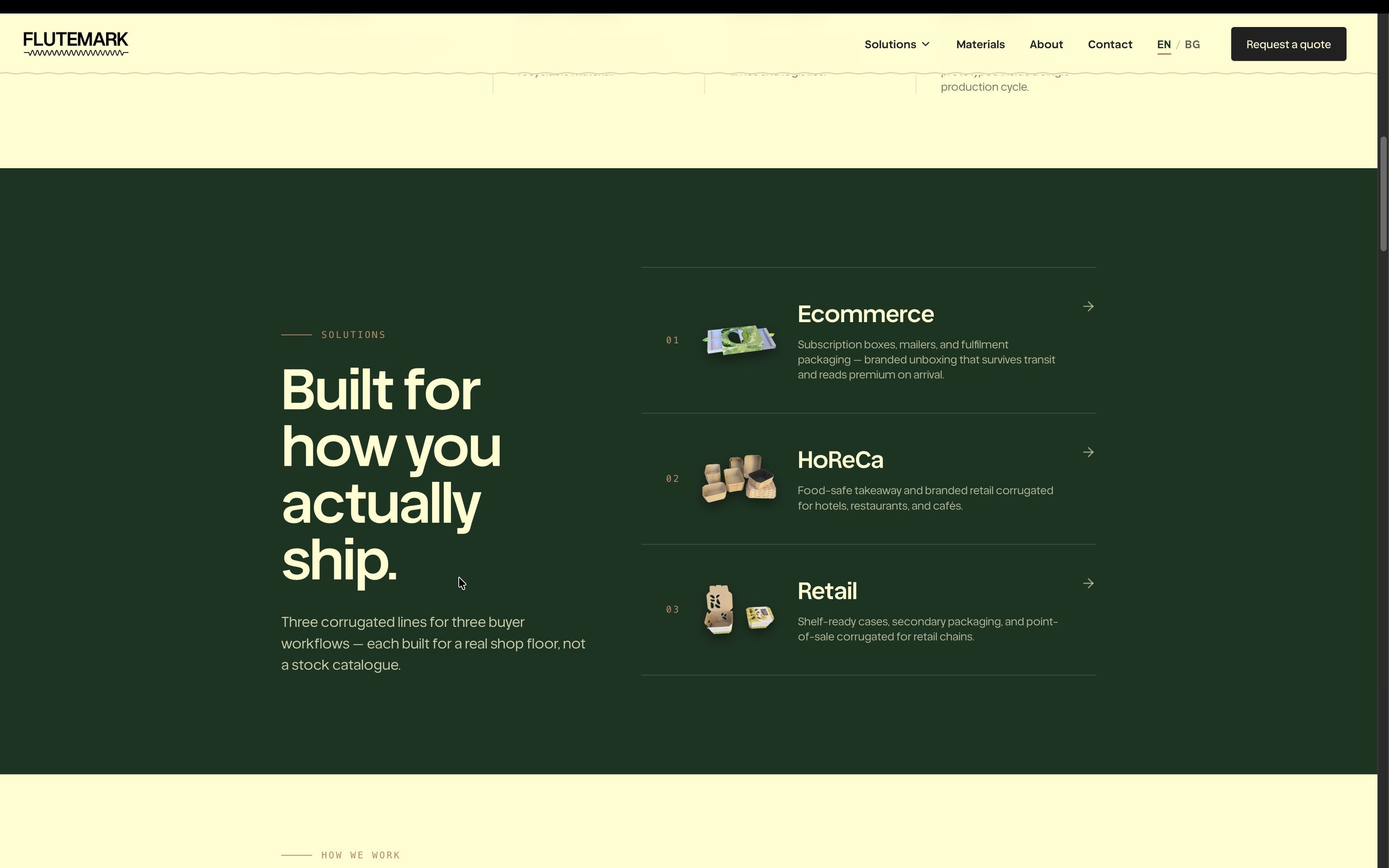
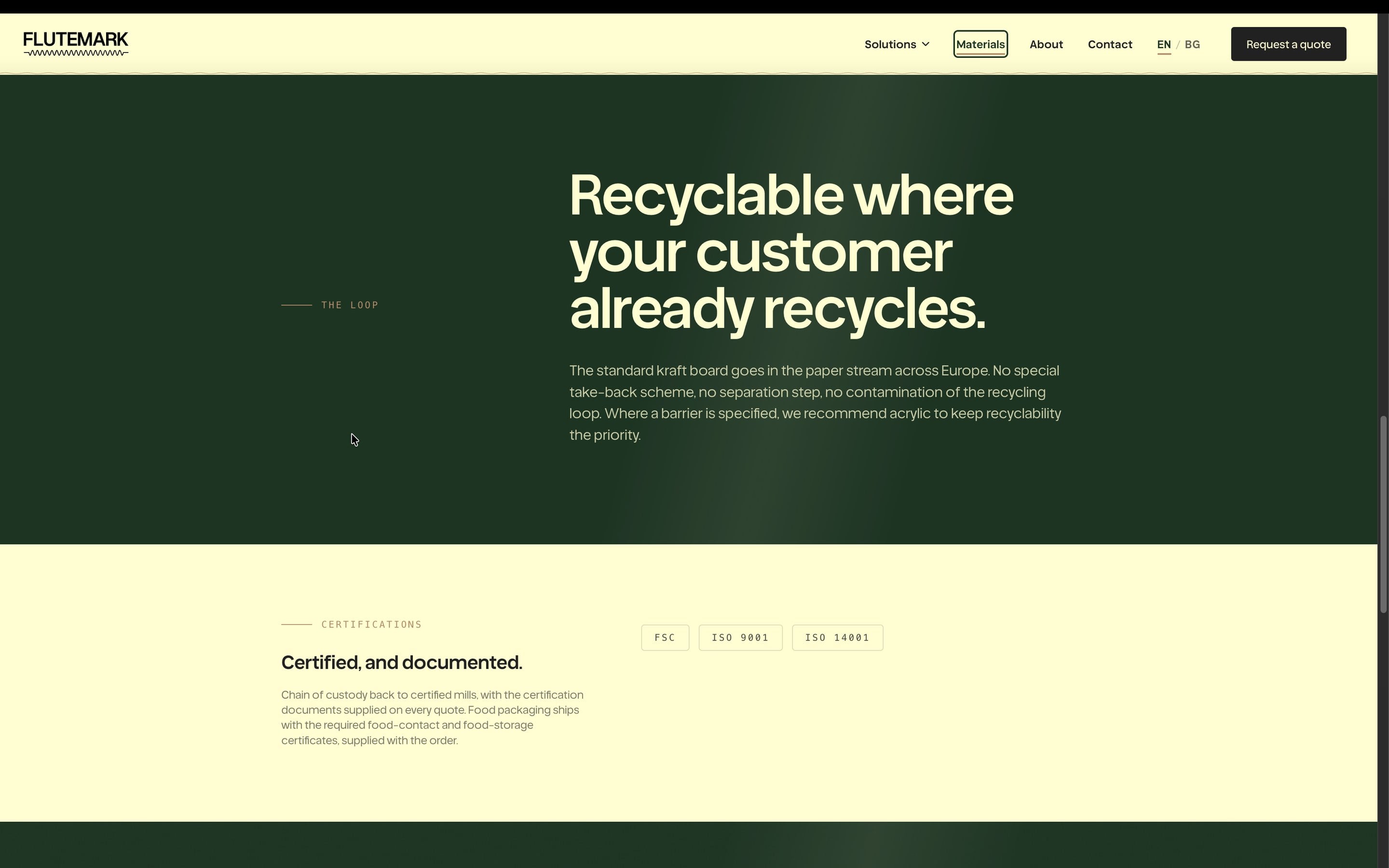
The Approach
We took it from name to launch as one engagement. Naming and three logo rounds settled the identity, then a full brand system followed: wordmark, the corrugated flute motif, a four-colour palette, the Helvena Grotesk type system, a pattern library and a brand guide, delivered as an audited package. On top of it we built the platform, a single design system and a real internationalisation architecture rather than a translated brochure: English is the shape authority and Bulgarian conforms to the same TypeScript type, so the compiler refuses to ship a half-translated page. Bilingual SEO is textbook (reciprocal hreflang, a self-canonical per locale, the bilingual sitemap submitted to Google Search Console), the site is statically prerendered with vite-react-ssg, and the Bulgarian surface tree-shakes out of the English build behind one flag. Conversion runs through Supabase Edge Functions with row-level security, server-side validation, per-IP rate limiting, and a honeypot we decoupled from its wire key after finding a misnamed one silently dropping real leads behind a success screen. Around it we stood up the operating layer: Google Workspace email with SPF and DMARC, a Google Drive brand library, and a print-ready QR code pack for boxes and collateral. Analytics is cookieless, so there is no consent banner. We hardened it on a real phone, then ran a single production cutover.
Designed to work
The Solution
A brand built from the name up
Naming, three logo rounds, and a full identity system: wordmark and corrugated flute device, a locked four-colour palette, the Helvena Grotesk type system, a pattern library, favicon suite, social and OG cards, and a brand guide. Delivered as a ~95-file package, audited file by file before release.
Four languages, one type contract
Every locale shares one TypeScript shape, so a missing translation fails the build instead of shipping. Launched in English and Bulgarian; French and German were added in August 2026 through the same contract, taking the sitemap from 18 to 36 URLs. Reciprocal hreflang and a self-canonical per locale give each language clean, independent SEO, and each non-English surface sits behind its own build flag.
Lead capture, and the infrastructure behind it
Multi-step quote and contact forms post to Supabase Edge Functions with row-level security, server-side validation and per-IP rate limiting; a honeypot that was silently dropping real leads behind a "thank you" was found in the logs and fixed. Behind it: Google Workspace email (SPF and DMARC, hello@ to both founders), a Google Drive brand library, and a print-ready QR code pack, shipped as one cookieless launch hardened on a real device.
The Results
Continue browsing
All work